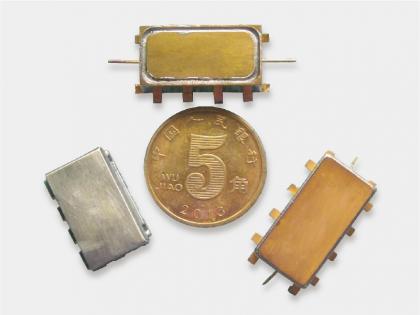
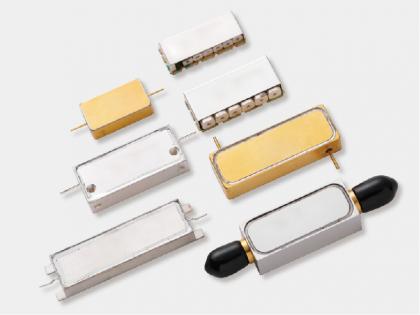
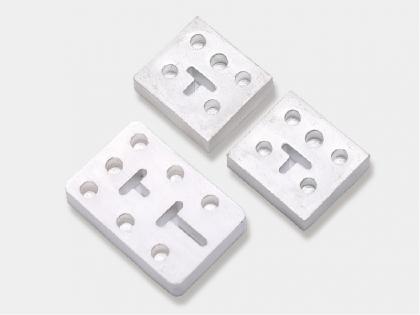
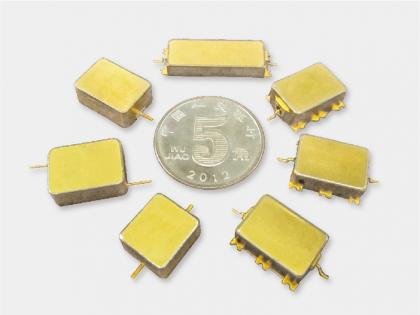
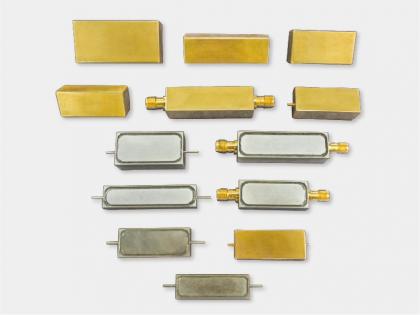
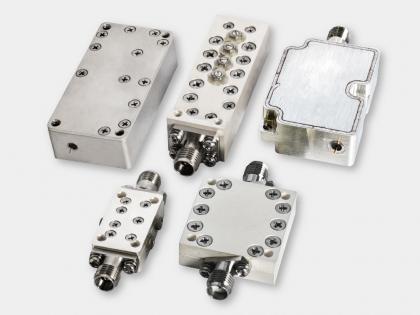
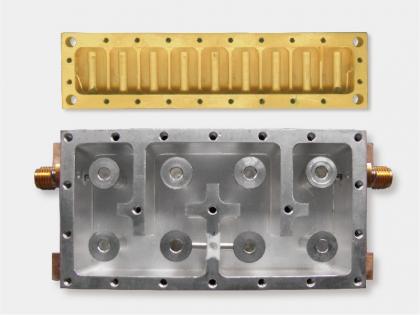
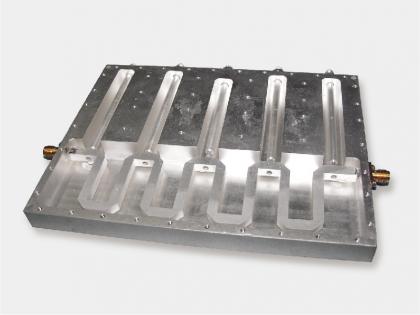
A cavity filter is a type of radio-frequency filter that achieves frequency selection by utilizing electromagnetic resonance within a metallic cavity. Its fundamental operating principle is based on resonance and coupling.
The cavity itself functions as a high-Q resonator. When the input signal frequency approaches the cavity’s natural resonant frequency, a stable standing electromagnetic wave is established inside the cavity, allowing energy to be efficiently coupled and transmitted to the output. Signals at non-resonant frequencies cannot form effective resonance within the cavity and are therefore strongly attenuated, resulting in the desired filtering effect.
In practical applications, multiple cavities are cascaded and coupled capacitively or inductively to form a multi-order filter structure, enabling the required bandwidth, selectivity, and out-of-band rejection. By adjusting the cavity dimensions, tuning screws, and inter-cavity coupling strength, the center frequency and frequency response can be precisely controlled. Consequently, cavity filters are widely used in RF and microwave systems that demand low loss, high power handling capability, and excellent frequency stability.
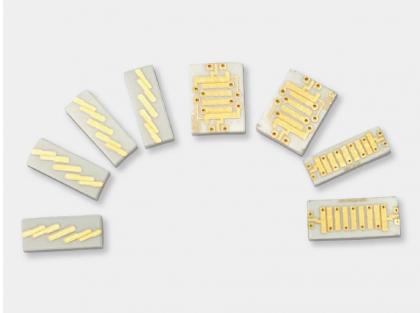
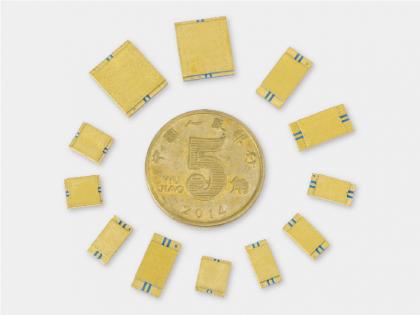
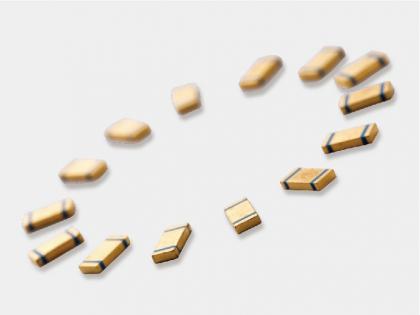
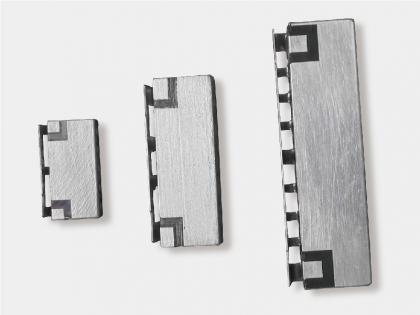
Yun Micro, as the professional manufacturer of rf passive components, can offer the cavity filters up 40GHz,which include band pass filter, low pass filter, high pass filter, band stop filter.
Welcome to contact us: liyong@blmicrowave.com


Address : Xisan Road, Mechanical and Electrical Industrial Park, No.767 Yulan Road, Hefei,Anhui.
Tel : +86-18855146875
Email : liyong@blmicrowave.com


Scan it